
the war of the worlds
book illustration
the project
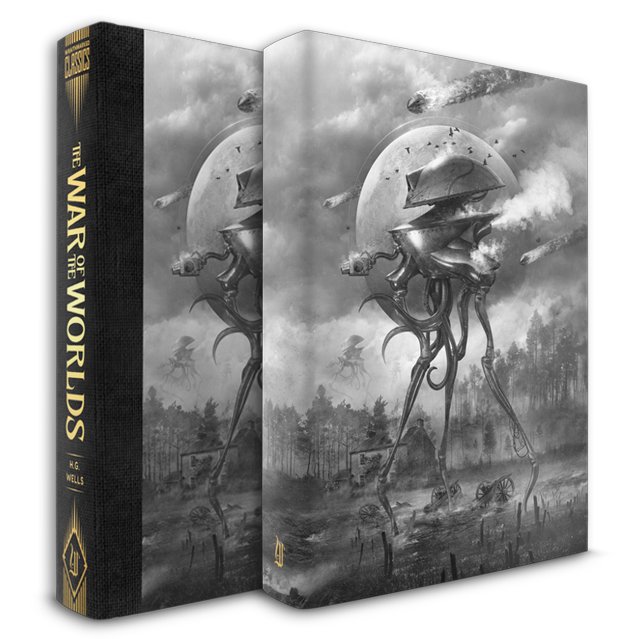
Wraithmarked Creative contacted me to work on interior art for their deluxe edition of The War of the Worlds by H. G. Wells. Creative direction by Daniel B. Greene.
The book featured high-end offset printing, a smyth-sewn binding, an attached ribbon bookmark, as well as metallic gilding of the page edges. Additionally, it included a full-art dust jacket and an illustrated cloth-bound case, featuring custom art by Dark Crayon.
My role in the project included illustrating 12 interior artworks and 2 endsheets in traditional ink, to compliment the narrative. Once all of my illustrations have been finished, approved and prepared for printing - Shawn T. King designed the book into a consistent volume.
the brief
The brief included a quotation from the book, describing Martians in a rather academic, dry fashion - contrasted with a peculiar curiosity mixed with anxiety among the observers. I've been offered a choice to either focus on the people, or the Martians.
Since my academic background lies in natural sciences, the decision was quick. I've studied illustrations in animal anatomy books for years, but despite working with pen and ink on a daily basis, I never really tried inking one myself - which made it a perfect occasion to clash those two worlds together.
Consequently, after gathering a decent amount of inspiration and reference imagery, I proceeded to planning the composition and preparing a 3x4 inch thumbnail sketch, in order to communicate the layout and general idea I wanted to convey in my response to the excerpts from the book and guidelines from the creative director.

the thumbnail
I aimed to create something resembling an era-appropriate medical illustration, historically most commonly drawn with pen and ink (and quite frequently with an addition of powdered graphite). Having in mind consistency with illustrations previously finished for this project I opted to add some stippling rather than limiting myself to linework and hatching - even though the latter would be more true to the main source of inspiration.
I chose to include three projections: a side view, the underside with internal organs and an anterior view with the whole body laid out flat - to show as much as I can on one page, while avoiding over-cluttering the composition.
The side view - and therefore the main visual characteristics of the creature - got rooted in a style test I've been assigned with prior to starting the work on this book.
Upon approval I proceeded to inking the anatomical concept piece in full scale:
Interior artwork for the Wraithmarked edition of H. G. Wells's The War of the Worlds. Illustrated with archival ink on A4 acid-free paper. Commercial project. © 2023 vvilczy. All Rights Reserved.
Interior artwork for the Wraithmarked edition of H. G. Wells's The War of the Worlds. Illustrated with archival ink on A4 acid-free paper. Commercial project. © 2023 vvilczy. All Rights Reserved.
Interior artwork for the Wraithmarked edition of H. G. Wells's The War of the Worlds. Illustrated with archival ink on A4 acid-free paper. Commercial project. © 2023 vvilczy. All Rights Reserved.
the lettering
Lettering included on the illustration had a separate thought process. Aside from the projection inscriptions I needed a name for the species. I didn't find any concrete information on that matter in the book, nor in related media.
My initial inclination was to settle for the latin Homo martiensis sapiens but considering the species most likely isn't directly related to humans - and even if, people wouldn't want to openly admit the affiliation - I abandoned the idea, and after additional research into cephalopods - I moved towards Martians' feeding habits as a plausible factor influencing the naming convention.
I decided on Vampyroteuthis martiensis, as a nod to Vampyroteuthis infernalis - a vampire squid, discovered around the time the book's action takes place, so it would be reasonable to assume people would name the Martians in a similar manner.
Having decided on the textual contents, I took a rough scan of the anatomy study and mocked up text addition digitally. To limit the risk of smearing the ink on this clean background I'd normally combine those two files into one deliverable at this stage. However, as the publisher acquired the original (physical) piece as well, I wanted it to work as a whole when viewed in person too - additionally, having it inked directly on paper limits potential discrepancies in lineweight and rendering accuracy.
In order to minimize the chance of ruining the work I've already done I lightboxed properly sized text back on the paper. Eventually, the illustration with the lettering has been scanned, vectorized and prepared for printing.
selected interior illustrations
Interior artwork for the Wraithmarked edition of H. G. Wells's The War of the Worlds. Illustrated with archival ink on A4 acid-free paper. Commercial project. © 2022 vvilczy. All Rights Reserved.
Interior artwork for the Wraithmarked edition of H. G. Wells's The War of the Worlds. Illustrated with archival ink on A4 acid-free paper. Commercial project. © 2023 vvilczy. All Rights Reserved.
Interior artwork for the Wraithmarked edition of H. G. Wells's The War of the Worlds. Illustrated with archival ink on A4 acid-free paper. Commercial project. © 2023 vvilczy. All Rights Reserved.
Interior artwork for the Wraithmarked edition of H. G. Wells's The War of the Worlds. Illustrated with archival ink on A4 acid-free paper. Commercial project. © 2022 vvilczy. All Rights Reserved.
Interior artwork for the Wraithmarked edition of H. G. Wells's The War of the Worlds. Illustrated with archival ink on A4 acid-free paper. Commercial project. © 2023 vvilczy. All Rights Reserved.
Interior artwork for the Wraithmarked edition of H. G. Wells's The War of the Worlds. Illustrated with archival ink on A4 acid-free paper. Commercial project. © 2023 vvilczy. All Rights Reserved.